
海苔のこと
01山本山の海苔{Yamamotoyama’s nori}
パリッと小気味よい歯応えと、海を感じる香りが広がる山本山の海苔。色・艶、香り、食感で厳選した豊富な種類の海苔商品をご用意しています。
Yamamotoyama’s nori seaweed offers a crisp,
satisfying bite and a scent that evokes the sea.
We offer a rich variety of nori products rigorously
selected for their color, luster, aroma, and texture.
-
- 焼海苔
- 香ばしい香りが食欲をそそる、風味豊かな焼海苔。
じっくりと焙煎した香ばしく深みのある香りと味わいを堪能できます。 - 香ばしい香りが食欲をそそる、風味豊かな焼海苔。
焙煎した香ばしく深みのある香りと味わいを堪能できます。
- Roasted nori
- The savory aroma of roasted nori stimulates the appetite, offering rich flavor. Enjoy the rich aroma and deep flavor of nori roasted to perfection.
-
- 味海苔
- 甘辛いタレのほか、梅やわさび、あおじそなど、フレーバーで選べるさまざまな味付海苔をご用意しています。
- 甘辛いタレのほか、梅やわさび、あおじそなど、フレーバーで選べるさまざまな味付海苔をご用意しています。
- Flavored nori
- In addition to sweet and savory sauce, we offer a variety of flavored nori, including options like plum, wasabi, and green shiso.
-
- のり:その他
- 風味豊かな海苔を風たっぷり味わえる、お茶漬け、佃煮、
おつまみなど、バラエティ豊かな海苔商品をご用意。ご飯のお供に、お酒のおつまみに、海苔の香りと旨みを存分に楽しめます。 - 風味豊かな海苔を風たっぷり味わえる、お茶漬け、佃煮、おつまみなど、バラエティ豊かな海苔商品をご用意。ご飯のお供に、お酒のおつまみに、海苔の香りと旨みを存分に楽しめます。
- Nori: other
- We offer a wide variety of nori products, including ochazuke, tsukudani, and snacks, all packed with richly flavored nori. Enjoy the rich aroma and savory flavor of nori as a perfect accompaniment to rice or as a snack with drinks.
-
- のりせんべい
- 「お茶と海苔の新しい楽しみ方を提供したい」という想いで作った山本山のお菓子。日本橋の老舗、山本山が作るおせんべいは海苔が主役。封を開けた瞬間から香りが広がる、まさに海苔を味わい尽くしていただける逸品です。
- 「お茶と海苔の新しい楽しみ方を提供したい」という想いで作った山本山のお菓子。日本橋の老舗、山本山が作るおせんべいは海苔が主役。封を開けた瞬間から香りが広がる、まさに海苔を味わい尽くしていただける逸品です。
- Nori rice crackers
- Yamamotoyama’s snacks were created out of a desire to offer a new way to enjoy tea and nori. Yamamotoyama, a long-established shop in Nihonbashi, makes rice crackers in which nori seaweed takes center stage. The moment you open the package, the rich aroma of nori fills the air—truly a masterpiece that lets you savor every bit of nori.
02海苔へのこだわり{Dedication to nori}
九代目 山本嘉兵衛は、有明産の最高品質の海苔に感銘を受け、紙の製造を行っていた創業の精神に立ち返り、海苔を山本山の一つの柱に据えました。
原料から加工まで一枚一枚にこだわりが詰まっています。
The ninth-generation Kahei Yamamoto was so impressed by the highest quality Ariake seaweed that he returned to the company’s founding spirit from the time when the company was engaged in paper manufacturing, and made seaweed one of Yamamotoyama’s pillars. Each sheet is made with meticulous care, from raw materials to processing.
海苔の作り方{How nori is made}
-
一、糸状体の培養管理(三~八月)Cultivation management of
filamentous bodies (March–August)カキ殻やホタテ貝殻にフリー糸状体や果胞子を植付け、培養を開始します。春から夏にかけて成長し殻胞子を作ります。秋になると殻胞子が成熟し放出されます。
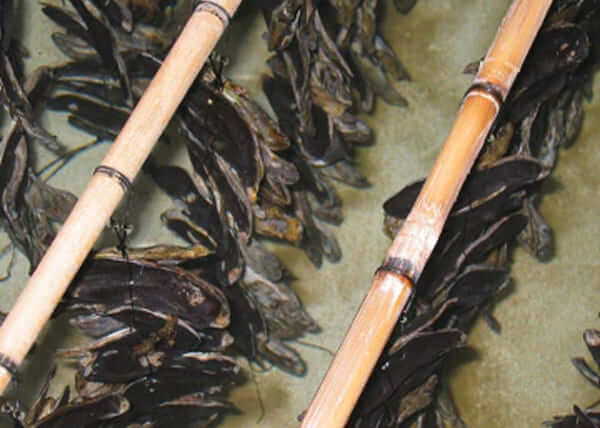
Cultivation begins with free filamentous bodies and carpospores being implanted onto oyster and scallop shells. They grow from spring to summer and create conchospores. In the fall, the conchospores mature and are released.
-
二、漁場の準備(九月)Preparing the aquaculture grounds (September)
養殖方式には、主に内湾や沿岸部で行う支柱式と沖合で行う浮流式のふたつがあります。支柱式漁場では、殻胞子の付着数を支柱の設置等、浮流式では養殖施設の準備を行います。
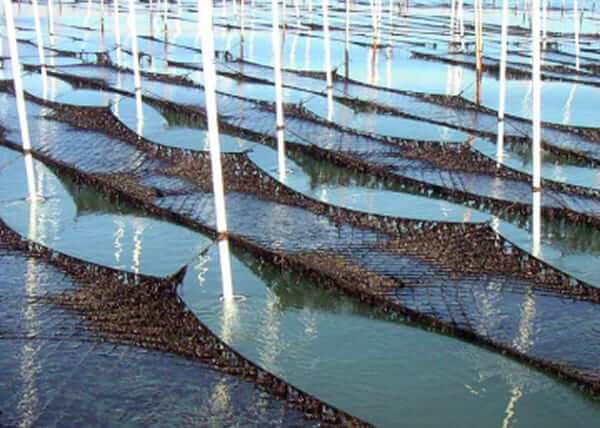
There are two main aquaculture methods: the stake-based system, primarily used in bays and coastal areas, and the floating system, used offshore. At stake-based aquaculture grounds, stakes and other equipment are installed, and for floating systems, aquaculture facilities are prepared.
-
三、陸上採苗(九月)Land-based conchospore seeding (September)
陸上に水槽を設置しその中に糸状体が生長した貝殻を入れ、水車にのり網を巻いて行う方法を陸上採苗といいます。殻胞子の付着数を調整しながら、計画的に採苗できます。現在はこの採苗方法が主流になってきています。殻胞子付着後、のり網を冷蔵庫で保存し海況が整えば海に張り出します。
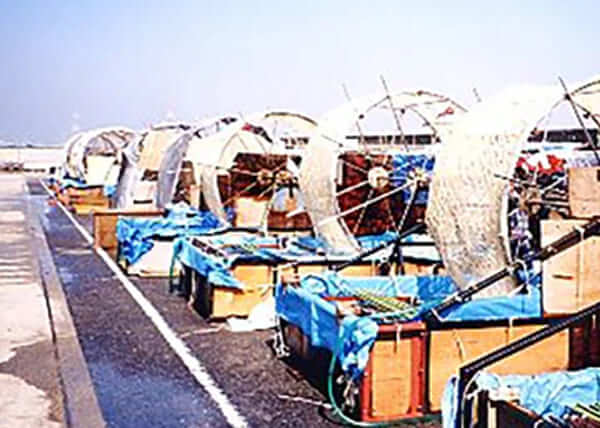
Land-based conchospore seeding refers to the method of installing tanks on land, placing shells with filamentous growth inside them, and then winding nets onto water wheels to allow the conchospores to attach to the nets. Seeding can be carried out systematically while adjusting the number of attached conchospores. This method of seeding has become the mainstream approach. After the conchospores are attached, the nori nets are stored in refrigerators, and when the sea conditions are favorable, they are deployed in the ocean.
-
四、育苗(十月)Seedling cultivation (October)
種の付いたのり網を漁場に張り込み育苗を行います。健全なのり芽を育苗するために、干出を行い、雑藻の付着を防ぎ、病害のない芽を育て、二次芽による増芽も促します。
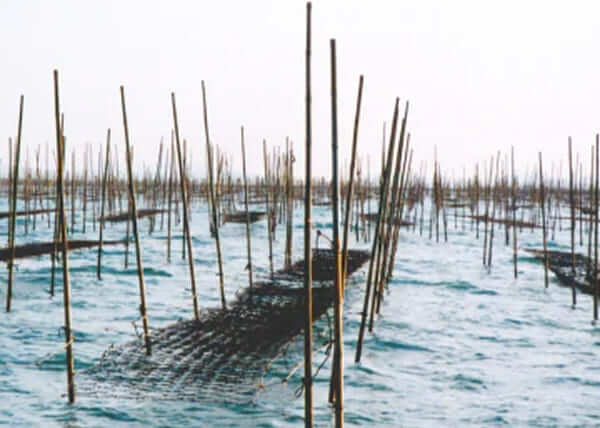
Seed-bearing nori nets are deployed at the aquaculture grounds and seedlings are cultivated. To cultivate healthy seaweed seedlings, drying is performed to prevent the attachment of unwanted algae, disease-free sprouts are grown, and secondary sprouting is promoted for increased yield.
-
五、生産期(十一~三月)Production period (November–March)
育苗が終わった網は、そのまま養殖を行う網(秋芽網)と二期作を行うために冷凍保存する網(冷凍網)に分けられます。一ヶ月程度で摘採できる大きさまで成長し、十二月以降は冷凍網を漁場へ張り出して、冷凍網の生産が行われます。
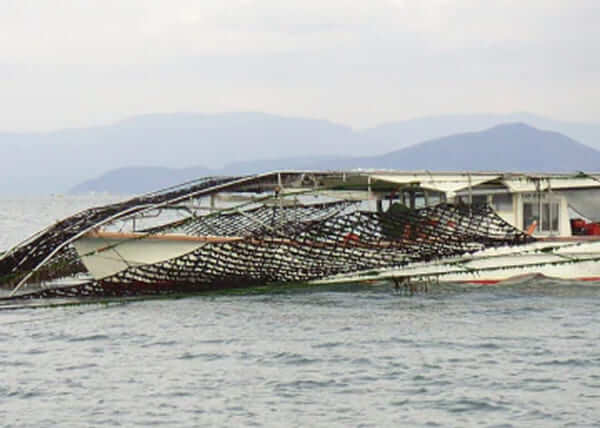
Nets used for seedling cultivation are divided into nets used right away for aquaculture (autumn seedling nets) and nets frozen for storage to enable two-crop cultivation (frozen nets). Within about a month, the seaweed grows to a harvestable size. Starting in December, frozen nets are deployed at the aquaculture grounds to begin nori production.
品質管理へのこだわり{Dedication to quality control}
-
- 其の一焼きのこだわり
- 海苔本来の特徴を最大限引き出すよう遠赤外線でムラなく焼き上げます。そうすることで、柔らかな口溶けと豊かな磯の香り、パリッとした触感が生まれます。
- 海苔本来の特徴を最大限引き出すよう遠赤外線でムラなく焼き上げます。そうすることで、柔らかな口溶けと豊かな磯の香り、パリッとした触感が生まれます。
- Dedication to roasting
- We evenly roast the nori using far-infrared heat to maximize the nori’s inherent characteristics. This creates a soft melt-in-your-mouth texture, a rich sea aroma, and a crisp bite.
-
- 其の二原料のこだわり
- おいしい海苔の産地として有名な「有明海産」にこだわり、大部分の商品の原料にしています。同じ有明海産でも年ごとに天候や海況等により品質はばらつきが生じますが、山本山では毎年その年に一番良い海苔の採れた浜から仕入れています。
- おいしい海苔の産地として有名な「有明海産」にこだわり、大部分の商品の原料にしています。同じ有明海産でも年ごとに天候や海況等により品質はばらつきが生じますが、山本山では毎年その年に一番良い海苔の採れた浜から仕入れています。
- Dedication to primary ingredients
- We are committed to using Ariake Sea-produced nori, renowned as a source of delicious seaweed, as the primary ingredient in most of our products. Even among products from the same Ariake Sea, quality varies from year to year due to weather and sea conditions. At Yamamotoyama, we source our nori annually from the beaches yielding the year’s finest harvest.
-
- 其の三味付のこだわり
- 山本山の味付海苔のタレは原材料にこだわって、化学調味料無添加で作られています。素材の味を存分に引き出すため、水を一切使用せず清酒と本みりんをベースとし、北海道羅臼産昆布と赤穂の天然塩など、天然素材の旨みを存分に引き出し「山本山の味」を現在に受け継ぎます。
- 山本山の味付海苔のタレは原材料にこだわって、化学調味料無添加で作られています。素材の味を存分に引き出すため、水を一切使用せず清酒と本みりんをベースとし、北海道羅臼産昆布と赤穂の天然塩など、天然素材の旨みを存分に引き出し「山本山の味」を現在に受け継ぎます。
- Dedication to flavorings
- Yamamotoyama’s flavored nori sauce is made with carefully selected ingredients and contains no chemical seasonings. To fully bring out the natural flavors of the ingredients, we use no water whatsoever, instead basing our recipe on sake and genuine mirin. We draw out the rich umami of natural ingredients like Rausu kelp from Hokkaido and natural salt from Ako, carrying forward the Yamamotoyama flavor to the present day.
海苔の楽しみ方{How to enjoy nori}
海苔を味わい尽くす海苔の七ヶ条{Savoring nori to the fullest: the seven principles of nori}
-
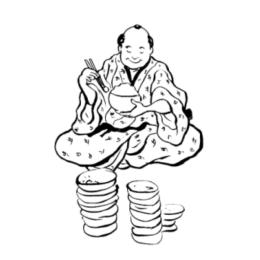
一、あらゆる食を体験することは粋なり
1. To experience all manner of food is the height of sophistication.
-
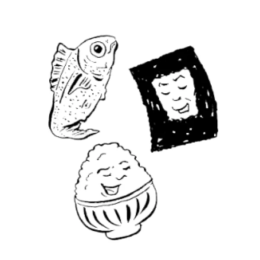
二、海苔とは食事に香ばしさを足す名脇役なり
2. Nori is the perfect supporting player that adds a savory aroma to meals.
-
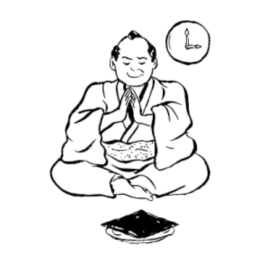
三、三時のおやつを海苔にすべし
3. Nori should be your afternoon snack.
-
四、パリっと一噛みし一息つくべし
4. Take a crisp bite and catch your breath.

-
五、艶ある深い黒緑色の海苔を探すべし
5. Seek out nori that is glossy with a deep blackish green color.

-
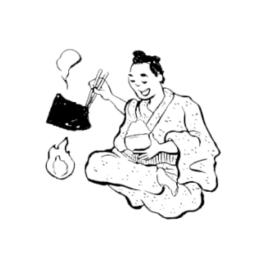
六、火で炙り、ごはんに散らすべし、即ち通な食べ方なり
6. Toast over a flame and scatter over rice—this is the connoisseur’s way of eating.
-
七、同じ店を極めこだわりの中の微差を感じるべし
7. Become an expert at the same store and learn to discern the subtle differences within its dedication.
- 海苔の裏表の使い分け
- 海苔には裏表があり、一般的にはツルツルしている面が表、ザラザラしている面が裏といわれています。
- 海苔には裏表があり、一般的にはルツルしている面が表、ザラザラしている面が裏といわれています。
- Using the front and back sides of nori
- Nori has a front and a back. Generally, it is said that the glossy side is the front and the textured side is the back.
- 〈表面〉
- 触り心地がツルツルしていて光沢があります。
表面の方が甘みがあります。巻き寿司やおにぎりに海苔を巻くときは、表面を外側にして巻くと光沢感があって見た目が良く、口当たりも良くなります。裏面にご飯に巻くことで、海苔がご飯にしっかりと密着して食べやすくなるという効果もあります。
- Front
- The front is smoothly textured and has a sheen. The front side is sweeter.
- 〈裏面〉
- 触り心地がザラザラしていて光沢がありません。
裏面の方が磯の香りが強いです。しょうゆを浸してご飯を巻いてそのまま食べる場合などは、表面にご飯をのせ、ザラザラの裏面を外側にするのがおすすめです。こうすることで、海苔の風味がより引き立つとともに、パリッとした食感を楽しめます。
- Back
- It feels rough to the touch and lacks luster. The back side has a stronger aroma of the sea.
When dipping nori in soy sauce and wrapping it around rice to eat as is, it is recommended to place the rice on the front side and have the rough back side facing outward. This enhances the flavor of the nori and allows you to enjoy its crisp texture.
海苔の保存方法{How to store nori}
- 〈開封前〉
- 開封前の海苔は、購入した袋のまま保存できます。
- 開封前の海苔は、購入した袋のまま保存できます。
- Before opening
- Unopened nori can be stored in the bag it came in.
- 〈開封後〉
- 海苔を開封したら、可能ならば密閉容器・袋に移し替えて保存しましょう。空気を抜いてから蓋をしっかりと閉め、食品乾燥剤と一緒に保存することで、より効果的に海苔を保存できます。
海苔が嫌う三大要素は「高温」 「湿気」「光」です。開封の有無にかかわらず、海苔を保存する際には直射日光が当たらない、涼しい場所を選びましょう。夏場など高温多湿の環境では冷蔵庫で保存すると良いでしょう。 - 海苔を開封したら、可能ならば密閉容器・袋に移し替えて保存しましょう。空気を抜いてから蓋をしっかりと閉め、食品乾燥剤と一緒に保存することで、より効果的に海苔を保存できます。
海苔が嫌う三大要素は「高温」 「湿気」「光」です。開封の有無にかかわらず、海苔を保存する際には直射日光が当たらない、涼しい場所を選びましょう。夏場など高温多湿の環境では冷蔵庫で保存すると良いでしょう。
- After opening
- Once you open the nori, transfer it to an airtight container or bag for storage if possible. After removing the air, close the lid tightly and store it with a food desiccant to preserve the nori more effectively.
The three major factors that spoil nori are high temperature, moisture, and light. Whether opened or unopened, store the nori in a cool place away from direct sunlight. During summer or in other hot and humid conditions, it is best to store it in the refrigerator.